Abstract: Against fierce industry competition and the pursuit of higher‑quality products, Taeda air‑swept calcination mill has become a mainstream option for FGD/desulfurization gypsum drying.
Desulfurization gypsum is a wet filter‑cake‑like material featuring high porosity and strong water‑retention capacity [1]. Its normal moisture content ranges from 18% to 25%, far higher than natural gypsum. It ranks among the most challenging materials for gypsum drying operations. Conventional dryers can realize drying, yet with unsatisfactory performance, high energy consumption and unstable product quality. Given moisture fluctuations in raw materials, such processes cannot guarantee uniform drying, resulting in greater quality deviation of final products. When further processed into recycled gypsum, the inconsistent feed will severely disturb calcination phase‑transition procedures and lead to sub‑standard finished‑product performance.
Equipment commonly recommended in the industry for one‑step drying includes TDGD steam dryers/rotary drum dryer/air‑swept calcination mill. The main challenge of this process lies in the high stickiness of desulfurization gypsum feedstock [2]. As an on‑site project engineer with 20 years of working experience, I will discuss the optimal equipment selection for desulfurization gypsum drying based on front‑line production practice and industry development background.
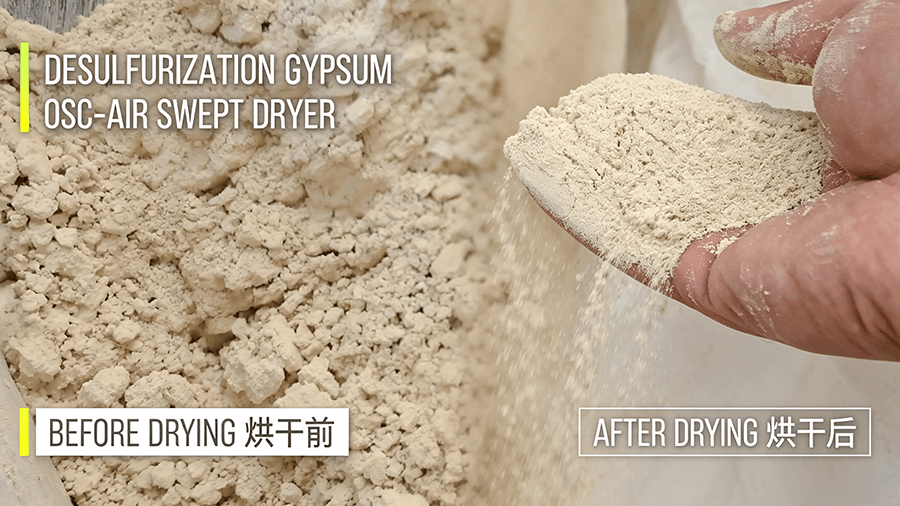
In the early days of desulfurization gypsum drying production, the industry largely adopted two types of traditional equipment: frying kettles and steam calciners. Originally designed for high‑temperature gypsum calcination, most of these units were second‑hand equipment phased out during production‑line technical retrofits. These retired devices were repurposed for desulfurization gypsum drying to extend their service life. Both are indirect‑heat‑transfer devices. Their advantage lies in precise temperature control, which effectively prevents over‑drying and crystal‑water loss, ensuring the output remains dehydrate gypsum raw material after drying. Nevertheless, they have obvious drawbacks. The strong stickiness of desulfurization gypsum readily causes material adhesion and blockage on equipment inner walls, requiring frequent shutdowns for manual cleaning and maintenance. Meanwhile, the indirect heat‑transfer mode delivers low thermal efficiency and keeps operating energy costs high. Such equipment was only suitable for small‑batch, low‑output extensive production in earlier years and has now been gradually phased out by the industry.
Around the turn of the millennium, the gypsum‑processing industry in Henan took the lead in applying optimized rotary drum dryers to desulfurization gypsum drying. Equipped with a chain‑grate furnace heat‑exchange system, the dryer cylinder is fitted internally with beating hammers, chains and material‑lifting dispersing structures. These designs effectively resolve caking and wall‑sticking problems of desulfurization gypsum filter cakes, greatly extending maintenance cycles and eliminating frequent shutdowns for cleaning. Thanks to its cost‑effective investment and simple operating procedures, it became the mainstream equipment for small‑and‑medium‑sized gypsum plants entering desulfurization gypsum processing at that time.
Nowadays, competition in the gypsum‑processing industry has become increasingly fierce, placing higher demands on manufacturers. Enterprises must not only guarantee stable and qualified product quality, but also strictly control production energy consumption and capital investment. Only by balancing quality and efficiency can firms gain a firm foothold in market competition and achieve long‑term profitability [3]. Technical shortcomings of rotary drum dryers have become fully exposed, making them no longer capable of meeting industrial development requirements.
In terms of production performance, rotary drum dryers agitate materials through cylinder rotation, resulting in limited uniformity of heat and air exposure. Drying dead zones cannot be completely eliminated, and partial uneven moisture distribution persists. It is difficult to stably reduce free moisture below 1.0%, the national premium‑grade standard. Fluctuating qualification rates and inconsistent product quality directly affect key indicators of subsequent calcined products such as strength and setting time.
From the perspective of energy consumption and site conditions, rotary drum dryers are bulky with substantial heat radiation loss, leading to low overall thermal efficiency and high unit energy consumption. Furthermore, they occupy large floor space and require heavy infrastructure investment. They fail to comply with current industrial policies for energy‑saving, cost‑reduction and clean production, and are only suitable for manufacturing low‑end gypsum products with low added value and loose quality requirements.
Since 2010, Taeda’s air‑swept calcination mill (Taeda Mill), developed by digesting advanced foreign technologies and relying on independent core intellectual property rights, has been officially launched on the market. It thoroughly addresses numerous pain points of conventional rotary drum dryers and old‑style calcination equipment, and has become the preferred equipment for large‑scale, high‑quality desulfurization gypsum drying to satisfy the industry’s core demands for quality improvement, cost reduction and high‑efficiency production.
Compared with traditional rotary drum dryers, the Taeda air‑swept calcination mill features integrated high‑efficiency production and excellent material adaptability as its primary advantage. The unit integrates multiple functions including crushing, dispersing, low‑temperature drying and preliminary grinding. Once high‑moisture sticky desulfurization gypsum filter cake is fed into the mill, high‑speed crushing and dispersion take place instantly to completely eliminate material caking. Combined with the dedicated low‑temperature hot‑air circulation system, materials achieve full‑range sufficient contact with hot air without drying dead zones.
Meanwhile, equipped with dedicated low‑temperature drying ducts and temperature‑control modules, the equipment delivers precise whole‑process temperature regulation. It strictly follows the drying principle of “removing only free moisture while preserving the complete crystal structure”, preventing premature loss of crystal water caused by local overheating. Qualified dehydrate gypsum raw material with moisture content below 1.0% can be stably produced, with product uniformity and qualification rate far exceeding those of rotary drum dryers.
Secondly, it delivers remarkable cost‑reduction and efficiency‑boosting benefits and is well‑suited for large‑scale production. Featuring a compact and short‑bodied structure, the air‑swept calcination mill greatly cuts floor space and installation height compared with bulky rotary drum dryers. It effectively reduces capital expenditure for plant infrastructure and site rental, simplifies production workflows and auxiliary equipment, and substantially shortens the commissioning cycle of production lines.
Boasting high hot‑air utilization and low energy loss, the equipment achieves a notable reduction in unit production energy consumption versus rotary drum dryers. With a high degree of automation and easy maintenance, it eliminates frequent shutdowns for sticky‑material cleaning, greatly improving equipment availability and cutting labor and maintenance costs. It perfectly meets the industry’s current core requirements for energy conservation and cost reduction.
Furthermore, as national policies for natural gas replacing coal continue to advance, low‑energy‑consumption operation has become essential for business survival. Both large‑scale manufacturers and small‑to‑medium‑sized joint‑venture enterprises need to seek new development paths.
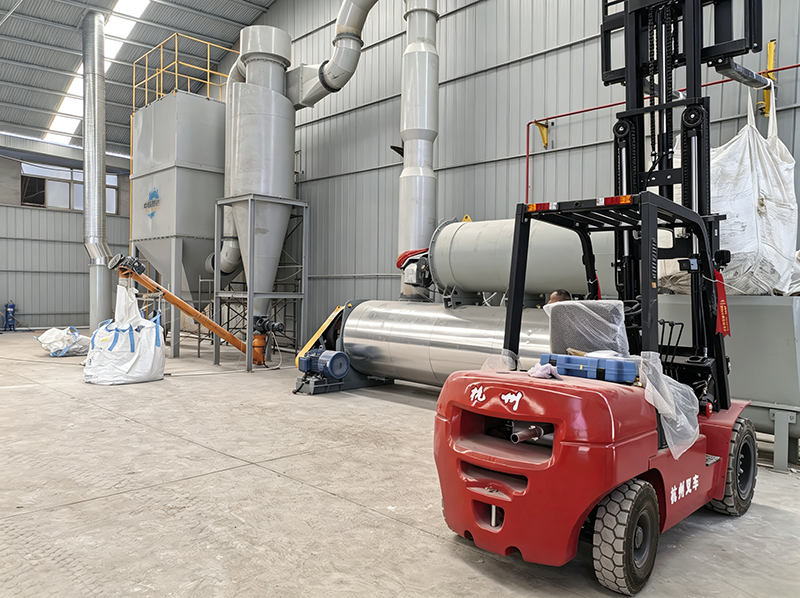
The pictures below show a case of a small‑scale plant adopting the air‑swept gypsum calcination mill for desulfurization gypsum drying. It features low labor input and small footprint with uniform product quality. In addition, the workshop maintains a clean working environment with minimal dust emissions.
In terms of industry application scenarios, the selection boundary between the two types of equipment is quite clear. Rotary drum dryers are only suitable for small‑and‑medium workshop‑style plants with limited budgets that conduct small‑scale extensive production and focus on low‑end, low‑added‑value products with loose requirements for finished‑product quality stability. They merely satisfy basic drying demands and offer no long‑term advantages in quality improvement and cost reduction.
By contrast, the Taeda air‑swept calcination mill fits mid‑to‑high‑end large‑scale production lines. It integrates multiple strengths including high‑quality drying, low energy consumption, low maintenance cost and flexible production. It helps enterprises achieve quality upgrading, cost reduction and revenue growth amid fierce market competition, and serves as the mainstream option for new‑build and revamped desulfurization gypsum drying production lines.
Based on the core logic of the gypsum industry — “Drying lays a solid foundation; calcination determines product quality”, desulfurization gypsum drying acts as a critical upstream process. Equipment selection directly governs the quality of subsequent finished products and production costs.
Driven by the general trend toward standardization, high‑quality output and energy‑saving development in the industry, rotary drum dryers featuring low precision, high energy consumption and unstable product quality will gradually withdraw from the mainstream market. The integrated, high‑precision and low‑energy‑consumption air‑swept calcination mill will become the core equipment for the efficient resource utilization of desulfurization gypsum.
[1 ] TAIDA GROUP. Technical Principles and Production Key Points of Gypsum Drying and Calcination[EB/OL]. (2026‑07‑22)[2026‑09‑02]. https://www.hntaida.com/news/company_news/619.html.
[2 ] TAIDA GROUP. Taeda Gypsum Calcining Technology Transfer FGD Gypsum into Resources for Reutilization[EB/OL]. (2026‑05‑21)[2026‑09‑02]. https://www.hntaida.com/news/company_news/614.html.
[ 3] TAIDA GROUP. Air‑Swept Calcination Mill: New Taida Technology Helps Gypsum Enterprises Reduce Costs and Boost Profits[EB/OL]. (2026‑07‑13)[2026‑09‑02]. https://www.hntaida.com/news/company_news/617.html.
Relative news

Wechat:#1 Dept.

Wechat:#2 Dept.