Gypsum calcination process is the core determinant of finished gypsum product quality. Amid increasingly fierce competition in the gypsum processing industry, the market has raised higher standards for manufacturers. Enterprises must not only guarantee stable and qualified product quality but also strictly control production energy consumption and investment costs. Only by balancing quality and efficiency can manufacturers gain a firm foothold in the industry and achieve long-term profitable operation.
At present, mainstream gypsum calcination equipment in the industry falls into three categories: rotary gypsum calcination kilns, flash calciners (fluidized bed calciners), and steam calciners. The air-swept gypsum calcination mill independently developed by Taida is an innovative integrated calcination technology that incorporates the core advantages of the three types of traditional equipment. Having been maturely applied in the gypsum industry for a decade and adopted by many key clients through strategic cooperation, this technology has gained wide professional recognition and endorsement.
1. Integrated Design Simplifies Production Processes
The Air-Swept Gypsum Drying & Calcining Mill is a high-efficiency all-in-one processing device that integrates crushing, grinding, drying and calcination functions. A single unit can complete the full production process of gypsum raw materials, from lump crushing and fine grinding to drying and calcination. It greatly streamlines the complicated traditional production workflow, reduces the number of supporting equipment, effectively cuts down the floor area of the production line, and lowers infrastructure and supporting costs. Thanks to its extensive application in the gypsum industry, it is universally known as the Air-Swept Gypsum Drying & Calcining Mill.
2. Optimized Mechanical Structure Eliminates Inherent Defects of Traditional Equipment
In terms of mechanical structure, the air-swept calcination mill combines the structural strengths of steam calciners and rotary calcination kilns. Although its drying chamber adopts a fixed structure, the exclusive internal air sweeping system achieves the same material propulsion and turnover effects as rotary cylinders. This fundamentally solves the inherent drawbacks of traditional fluidized bed calciners, including uncontrollable material retention time and poor compatibility with materials of different fineness and moisture content.
Conventional fluidized bed calciners commonly suffer from uneven calcination and unstable finished product quality. In contrast, the air-swept calcination mill adopts an efficient air sweeping disturbance structure to ensure uniform force and heat distribution on materials throughout the processing procedure. It eliminates the above defects from the source and adapts to diverse raw material production conditions.
3. Full-Range Uniform Calcination Supports Flexible Switching of Multiple Raw Materials
After entering the first chamber of the equipment, gypsum raw materials are rapidly crushed and decomposed to form a mixed flow of powder, gas and particles, which disperses densely in the front cavity and maintains continuous rolling and sufficient mixing. This structural design ensures highly consistent material temperature and composition in the first chamber, avoiding local uneven calcination.
When materials flow into the second chamber, three sets of adaptive rotor structures conduct deep calcination on semi-calcined materials to efficiently remove crystal water from the materials. To meet enterprises’ demand for raw material switching between peak and off-seasons, the equipment is compatible with multiple raw materials including natural gypsum and industrial by-product gypsum. Production switching can be completed quickly by slightly adjusting the air sweeping parameters and operating conditions of the first chamber, the second chamber and the third finished product chamber, delivering outstanding flexible production capacity.
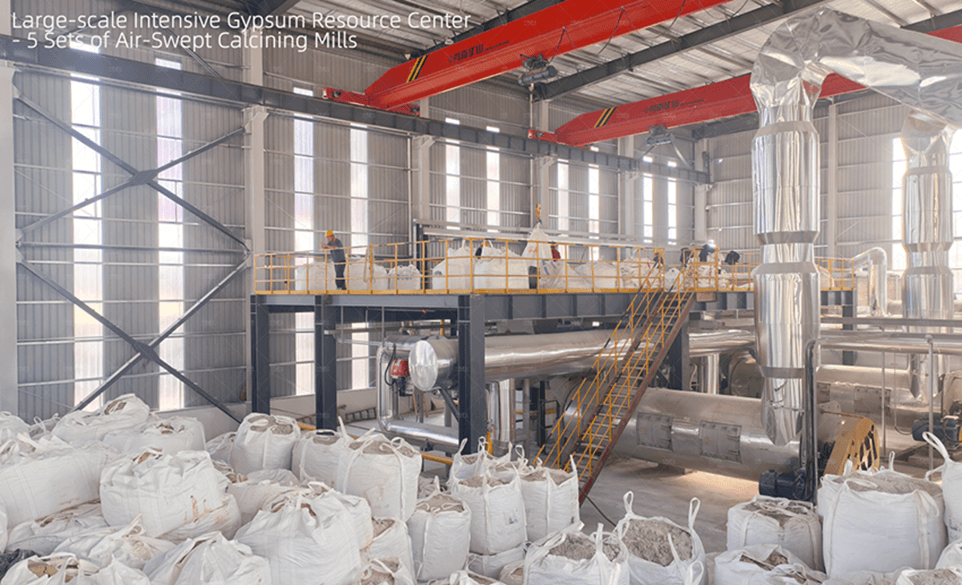
4. Reduced Floor Area and Investment Lower Production Launch Threshold
Compared with traditional calcination equipment, the air-swept calcination mill features a compact and shorter body, which greatly reduces the installation height and floor area of the main unit and supporting auxiliary equipment. It effectively cuts down factory infrastructure investment and site rental costs, simplifies equipment installation procedures, and shortens the production line commissioning cycle. This helps enterprises launch production rapidly and recover capital costs in a timely manner.
5. Dual Temperature Control Ensures Stable and Controllable Finished Product Quality
Precise temperature control is the core guarantee for finished gypsum quality. The air-swept calcination mill is equipped with a T0/T2 dual temperature control system and a secondary calcination furnace tube at the main mill outlet to realize segmented and accurate temperature regulation. Materials inside the main calcination mill maintain a uniform state, which avoids the mixing of dihydrate gypsum, hemihydrate gypsum and anhydrite in finished products. Fine-tuning the T2 temperature of the secondary calcination furnace tube is sufficient to stabilize product indicators. It inherently solves the common quality problem of mixed gypsum phases in traditional calcination equipment, forming a unique quality advantage.
In addition, the equipment delivers output materials with uniform and stable temperature. The consistent temperature of finished gypsum enables rapid and uniform aging in the aging silo, significantly improving the stability and consistency of final products and enhancing market competitiveness.
6. High Cost Performance Boosts Production Benefits Significantly
Compared with mainstream equipment such as steam rotary kilns and imported Peters Mills, the air-swept calcination mill boasts prominent cost-performance advantages. Under the same production capacity, steam rotary kilns and Peters Mills require extremely high costs for equipment procurement, installation and maintenance, bringing huge upfront investment pressure to enterprises.
In contrast, Taida’s air-swept calcination mill benefits from an optimized two-stage calcination structure and years of iterative upgrading of calcium-based material calcination technology. It features mature performance, lower energy consumption and simpler operation and maintenance. With lower upfront investment, reduced later operation and maintenance costs and higher production efficiency, it helps gypsum manufacturers cut operational costs, improve product quality and increase economic returns. It is the preferred equipment for new gypsum calcination production lines and the upgrading and renovation of existing production lines.
Relative news

Wechat:#1 Dept.

Wechat:#2 Dept.